
The Kansas City metropolitan area spans the state line between Missouri and Kansas, giving homebuyers distinct choices in property types, tax structures, and daily routines. Buyers interested in living in Kansas City often focus on the urban core of the Missouri side, while those looking to the Kansas side frequently explore Johnson County suburbs.
Lenexa sits about 15 miles southwest of downtown Kansas City, offering a different pace and housing inventory. Deciding between Kansas City and Lenexa comes down to weighing urban density against suburban development, along with differences in real estate prices, property taxes, and school district boundaries.
Comparing the Urban Core to Suburban Johnson County
Kansas City, Missouri covers over 319 square miles, featuring historic neighborhoods, downtown high-rises, and established commercial districts. Buyers here find diverse property types, including century-old brick homes in midtown and modern condominiums near the streetcar line. The city provides immediate access to large-scale infrastructure, major employers, and dense commercial zones.
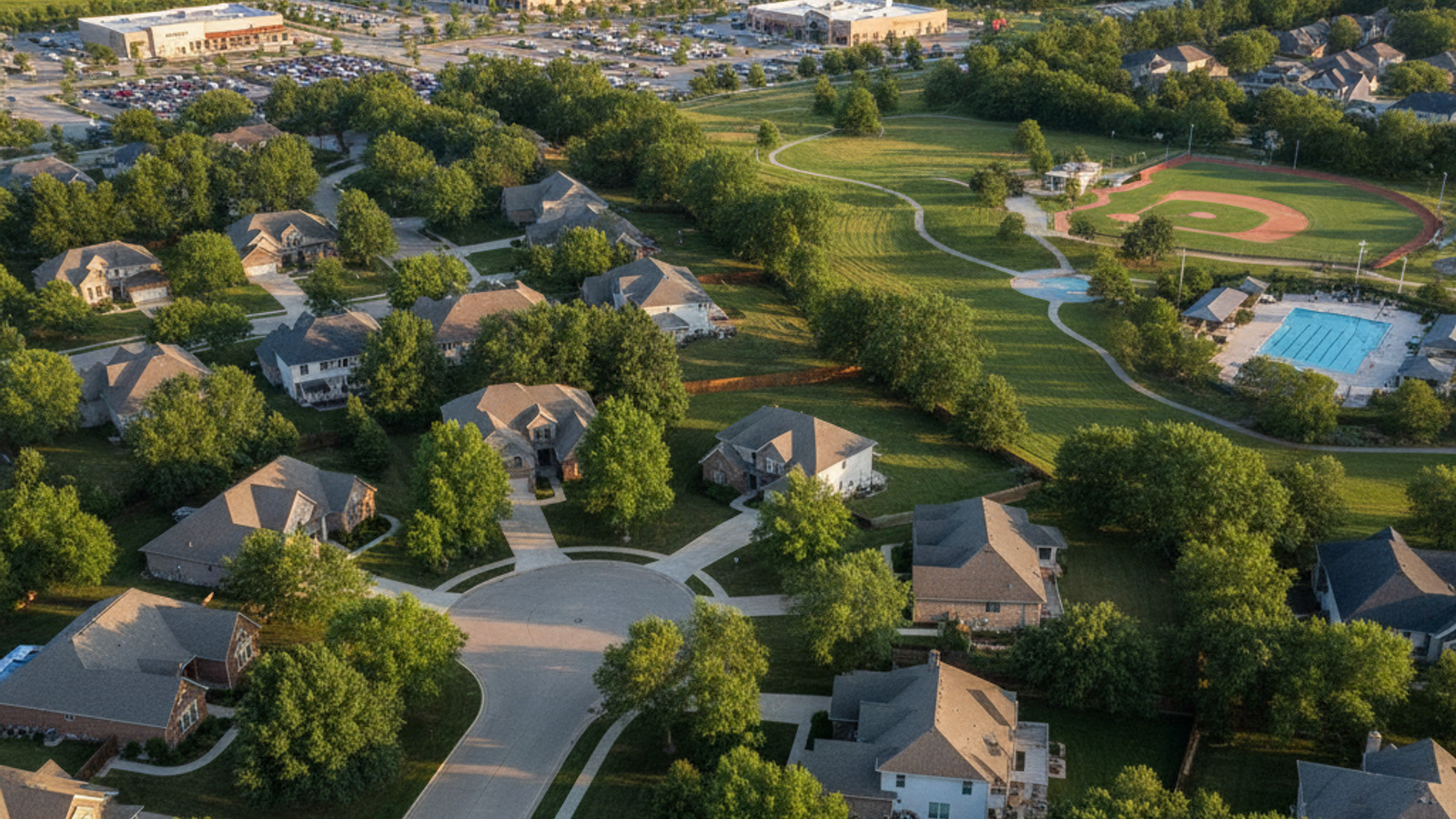
Lenexa occupies roughly 34 square miles in Johnson County, Kansas, characterized by newer single-family subdivisions and planned mixed-use developments. The housing inventory consists primarily of detached homes on larger lots, with recent construction expanding westward toward Olathe. Commercial activity centers around planned retail corridors rather than dense downtown blocks.
The state line divides more than just geography; it dictates tax rates, municipal services, and school systems. Buyers moving to the metro area should decide whether they prefer the immediate proximity of Missouri’s urban amenities or the suburban layout of Kansas.
Home Prices, Property Taxes, and the Cost of Living
The median sale price in Kansas City, MO sits around $325,000 as of mid-2026, with homes spending roughly 21 days on the market. In contrast, Lenexa commands higher housing costs, with median prices ranging from $484,000 to $530,000. Buyers evaluating Johnson County will generally find larger square footage and newer construction, which drives the higher baseline price point.
Property tax structures differ noticeably between the two jurisdictions. In Johnson County, Kansas, residential property is assessed at 11.5% of its appraised value, and Lenexa homeowners generally see an effective tax rate around 1.09%. This rate applies uniformly across the city’s primary residential zones.
Across the state line in Jackson County, Missouri, residential real estate carries a 19% assessment ratio. While Kansas City’s baseline home prices are lower, buyers should factor individual school district levies into their monthly mortgage calculations, as these can push the effective tax rate higher depending on the specific neighborhood.
Highway Access and Commute Times
Driving from central Lenexa to downtown Kansas City takes 18 to 20 minutes outside of peak rush hour traffic. The route covers approximately 15 miles, primarily utilizing Interstate 35. Morning and evening commute times increase depending on congestion near the state line and the downtown loop.
Interstate 435 also runs through Lenexa, providing a loop around the entire metropolitan area. This highway access connects residents to other Johnson County suburbs like Overland Park and Shawnee, as well as the Kansas City International Airport to the north.
Public transportation options vary by location. Kansas City operates a free downtown streetcar and an extensive local bus network, making car-free transit viable in the urban core. Lenexa residents rely on regional bus services connecting Johnson County transit centers to downtown Missouri, which operate on fixed commuter schedules.
Parks, Shopping Centers, and Local Entertainment
Kansas City maintains over 220 parks, including the 1,805-acre Swope Park, which houses the Kansas City Zoo and an outdoor amphitheater. The city also offers dense entertainment districts like the Power & Light District and the Crossroads Arts District, where residents can walk between dozens of restaurants and venues.
Lenexa provides localized recreational facilities, centered around spaces like Sar-Ko-Par Trails Park and its surrounding trail network. The city has also developed the Lenexa Public Market, a food hall and gathering space within its newer civic center. Retail in Lenexa relies on shopping centers with dedicated parking lots rather than pedestrian-focused downtown streets.
Buyers seeking large-scale professional sports, major concert venues, and extensive nightlife will find those primarily on the Missouri side. Those looking for neighborhood walking trails, community pools, and suburban retail centers often favor the layout of Lenexa.
Regional School Districts and Healthcare Infrastructure
The Shawnee Mission School District serves the majority of Lenexa, enrolling over 26,000 students across its elementary, middle, and high schools. This district covers several Johnson County municipalities and is a primary factor for many buyers choosing the Kansas side of the metro.
Kansas City Public Schools operates within the urban core of Missouri, serving roughly 15,000 students. Buyers looking at Kansas City proper also have access to numerous charter schools and private academies located throughout the urban and midtown neighborhoods.
The metropolitan area features a broad healthcare network accessible from both cities. Major facilities like Saint Luke’s Hospital and the University of Kansas (KU) Medical Center sit near the state line, keeping medical care within a short drive for residents in either location.
Frequently Asked Questions
Is Lenexa considered part of Kansas City?
Lenexa is an independent municipality in Kansas, but it sits within the larger Kansas City metropolitan area. It operates with its own city government, police force, and civic services.
How long is the commute from Lenexa to downtown Kansas City, MO?
The drive typically takes 18 to 20 minutes under normal traffic conditions. The trip covers roughly 15 miles along Interstate 35.
What is the cost of living in Lenexa, KS compared to Kansas City, MO?
Housing costs are the primary differentiator, with Lenexa homes often listing well above the $325,000 median found in Kansas City. Kansas City residents face a 1% municipal earnings tax and potentially higher effective property tax rates depending on the county.
Which school district serves Lenexa, Kansas?
The Shawnee Mission School District covers most residential addresses in Lenexa. A small portion of the city’s western edge falls within the Olathe Public Schools boundary.
What are the pros and cons of living in Lenexa, KS versus Kansas City, MO?
Lenexa offers newer housing developments and extensive community trail systems, but requires a longer drive to major cultural events. Kansas City provides immediate access to professional sports and historic architecture, but features older infrastructure and a denser urban environment.
If I buy a home in Lenexa but work in Kansas City, MO, do I have to pay the city earnings tax?
Yes, anyone who works within the Kansas City, MO city limits must pay the 1% earnings tax, regardless of where they live. If you live in Lenexa and work remotely for a company based outside of Kansas City, you do not owe this tax.

Dani Beyer, a Kansas City native, began her career in real estate in 2004 after working in the tech industry. Since then, she's helped thousands of families turn their dreams into keys! Dani is now the CEO and Lead Listing Specialist of 'Dani Beyer Real Estate' brokered with Keller Williams KC North. With 820+ Five Star reviews, she specializes in helping buyer and sellers in the Kansas City Northland.