
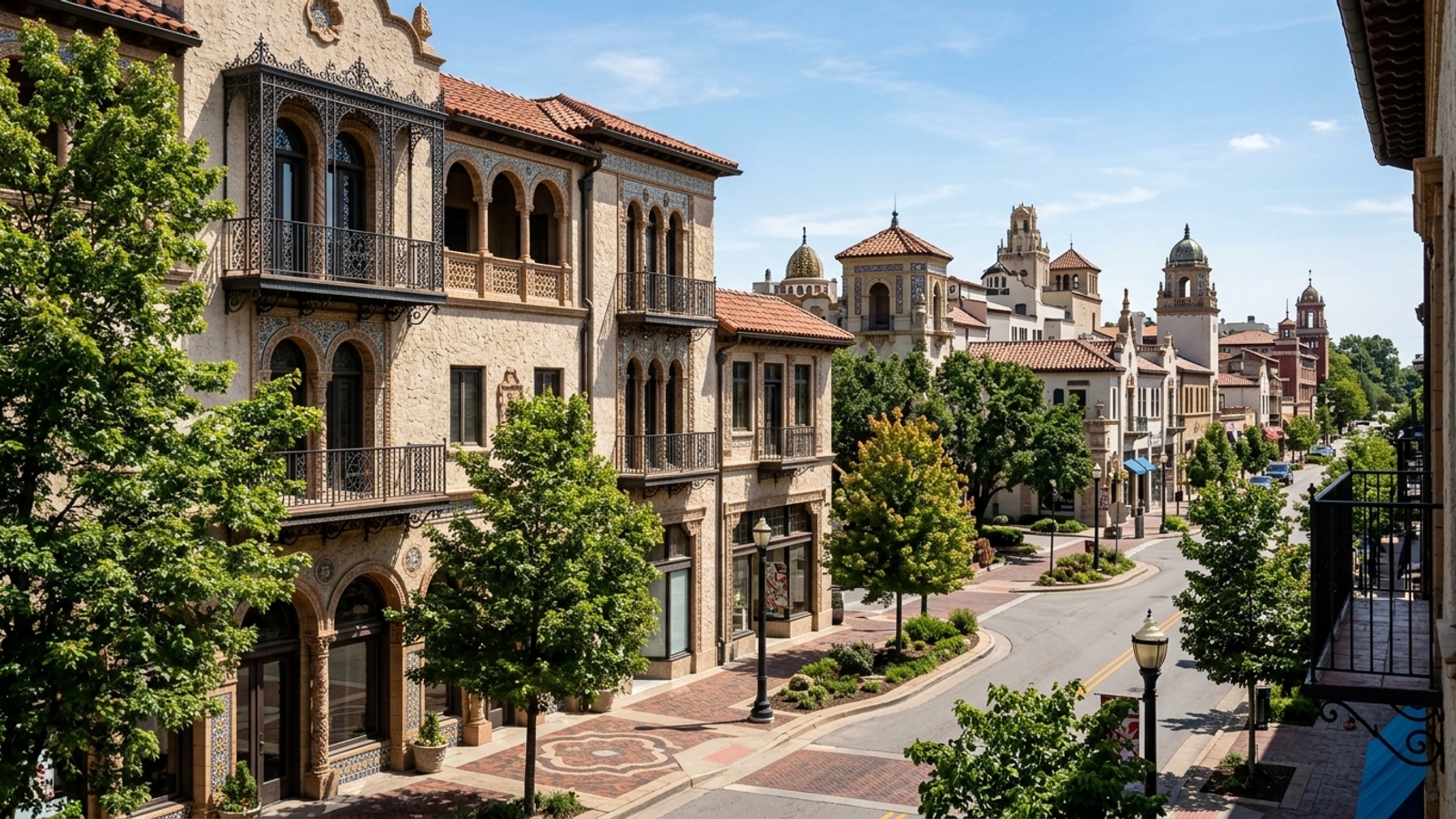
Buyers looking at Jackson County real estate often find themselves weighing Midtown vs Plaza. These are often considered two of the best neighborhoods in Kansas City, MO. Both areas have real historic character and sit close to the city center, but their housing markets and day-to-day rhythms are genuinely different things.
Across Kansas City, MO, the median home sale price sits around $325,000, and homes spend roughly 21 days on the market. Buy in either of these central corridors, though, and you’re shopping at a higher price point than that. Knowing how the property types, local amenities, and transit options stack up will go a long way toward figuring out which one actually fits your budget and plans.
What to Know About Midtown and the Country Club Plaza
Midtown and the Country Club Plaza sit just south of downtown Kansas City, MO. They border each other, but they were built with entirely different intentions. Midtown is largely a collection of early 20th-century residential neighborhoods. The Plaza was designed from the start as a unified commercial and residential district – a different animal entirely.
The opening of the KC Streetcar Main Street Extension on October 24, 2025, tightened the connection between these two locations. The 3.5-mile expansion added 16 stops, linking Union Station and downtown straight through Midtown, Westport, and the Art Museum District down to UMKC and the Plaza. Streetcars run in dedicated transit-only lanes, reaching speeds around 30 mph in certain sections of the corridor – which matters if you’re thinking about daily commutes and whether you actually need two cars.
Getting Around Kansas City
The new streetcar line features a signature Plaza Transit Center, making it straightforward to commute north into downtown. For broader bus service, RideKC routes 35, 47, and 401 also run directly through the Plaza area.
Midtown residents benefit from stops scattered along Main Street. Residents in nearby historic condo buildings – like the Battery Lofts – can step out their front door and catch a ride. That’s not nothing when you’re deciding between walkable urban living and somewhere that requires a car for everything.
Local Architecture and Housing Styles
Midtown is known for its diverse early 1900s to 1920s residential architecture. You’ll find classic Kansas City Shirtwaist homes, American Foursquares, Craftsman bungalows, and Tudor and Colonial Revivals in neighborhoods like Hyde Park, Volker, and Valentine.
The Country Club Plaza is a different story. Developer J.C. Nichols built it in the 1920s with a Spanish Baroque Revival and Moorish aesthetic drawn from Seville, Spain. Buildings feature ornate tilework, iron details, domes, and towers – including the 138-foot Giralda Tower, a half-scale replica of Seville’s bell tower. It’s cohesive in a way that’s unusual for an American commercial district.
Housing Prices and Real Estate Trends
The broader Kansas City market remains active, with about 2.1 months of housing supply available. Homes move relatively quickly, but if you’re targeting Midtown or the Plaza, plan on prices well above the citywide median.
The gap between the two areas is real and worth taking seriously. Depending on property type and exact location, you can expect to pay anywhere from roughly $103,000 to over $350,000 more for a Plaza property than a comparable Midtown home.
What to Expect in Midtown
Midtown is the more accessible entry point for buyers who want historic character without being too far from the city center. Median home sale prices here range from about $398,000 to $410,000.
That price point often gets you a single-family home with original architectural details intact – real millwork, solid bones, the kind of stuff that’s hard to replicate. Inventory runs mostly toward detached houses with yards, though condo conversions are available along the main transit corridors if that’s what you’re after.
Buying on the Plaza
Plaza real estate carries a premium, full stop. Median sale prices range from roughly $512,500 to as high as $758,751, depending on the specific property type and location within the district.
You’re looking at a mix of luxury condominiums and high-end single-family homes on the district’s edges. What you’re paying for, beyond the square footage, is immediate proximity to the shopping district and a historic streetscape that’s been maintained with unusual consistency.
Neighborhood Amenities and Daily Life
Day-to-day life in both areas revolves around local business districts and historic green spaces, but the feel is different. The Plaza operates as a regional destination. Midtown functions more as a patchwork of distinct local neighborhoods where the commercial energy is scattered rather than concentrated.
Both locations offer solid walkability. The destinations just aren’t the same – Plaza residents walk to luxury retail and dining, while Midtown residents are more likely to be heading to local entertainment districts and neighborhood parks.
Dining and Shopping
The Country Club Plaza is a premier open-air shopping district spanning 15 city blocks, with over 100 stores and more than 30 restaurants. Luxury retailers include Coach, Tiffany & Co., and Tivol, a local jeweler that’s been operating since 1910.
Midtown commercial activity centers around the Westport entertainment district and the Main Street corridor – independent local businesses, including Bubble Wrapp, a popular toy store at Westport Road and Main Street. It’s a different register entirely from the Plaza’s curated retail mix, and for some buyers that’s exactly the point.
Parks and Outdoor Recreation
The Plaza neighborhood contains seven different parks. Mill Creek Park is the main draw, with a popular jogging path and a fountain formerly known as the J.C. Nichols Memorial Fountain. Southmoreland Park, nearby, provides a playground and open green space.
Midtown has the expansive Hyde Park historic district, plus Murray Davis Park – which recently hosted the community celebration for the streetcar extension opening, with local food and music.
Frequently Asked Questions
What is the average difference in home prices between Midtown and the Country Club Plaza in Kansas City?
The difference ranges from roughly $103,000 to over $350,000. Midtown median prices sit near $398,000 to $410,000, while Plaza medians range from $512,500 to $758,751 depending on the specific property type.
How will the KC Streetcar extension impact property values in Midtown versus the Plaza?
It depends on the specific property, but both areas benefit from the October 2025 extension. The 3.5-mile line connects Midtown directly to the new Plaza Transit Center, giving residents in both locations a 30-mph transit option in dedicated lanes.
Which Kansas City neighborhood offers a better lifestyle for young professionals: Midtown or the Plaza?
It depends on what you actually want day-to-day. The Plaza offers 15 blocks of open-air luxury retail and dining, while Midtown puts you closer to the Westport entertainment district and independent local businesses. Both areas connect to downtown via the new streetcar extension.
Is parking a bigger issue when buying a condo on the Plaza or a historic single-family home in Midtown KC?
It depends on the exact property. Midtown features many detached historic homes built between the early 1900s and 1920s, while the Plaza offers high-density commercial blocks and condo buildings. Ask your agent about the specific parking arrangements for any listing you tour before you get too attached to it.
Do properties typically sell faster in Midtown Kansas City, MO compared to Plaza area real estate?
It depends on the specific listing and price point. Across Kansas City as a whole, homes spend a median of about 21 days on the market. Ask your agent for the current days on market for your specific target property type in whichever neighborhood you’re focused on.
If I am priced out of both Midtown and the Plaza, what are the best alternative neighborhoods in Kansas City, MO?
Expand your search across Jackson County and the broader city. The citywide median sale price in Kansas City sits around $325,000 – significantly lower than the entry point for either Midtown or the Plaza – which opens up considerably more options.

Dani Beyer, a Kansas City native, began her career in real estate in 2004 after working in the tech industry. Since then, she's helped thousands of families turn their dreams into keys! Dani is now the CEO and Lead Listing Specialist of 'Dani Beyer Real Estate' brokered with Keller Williams KC North. With 820+ Five Star reviews, she specializes in helping buyer and sellers in the Kansas City Northland.