
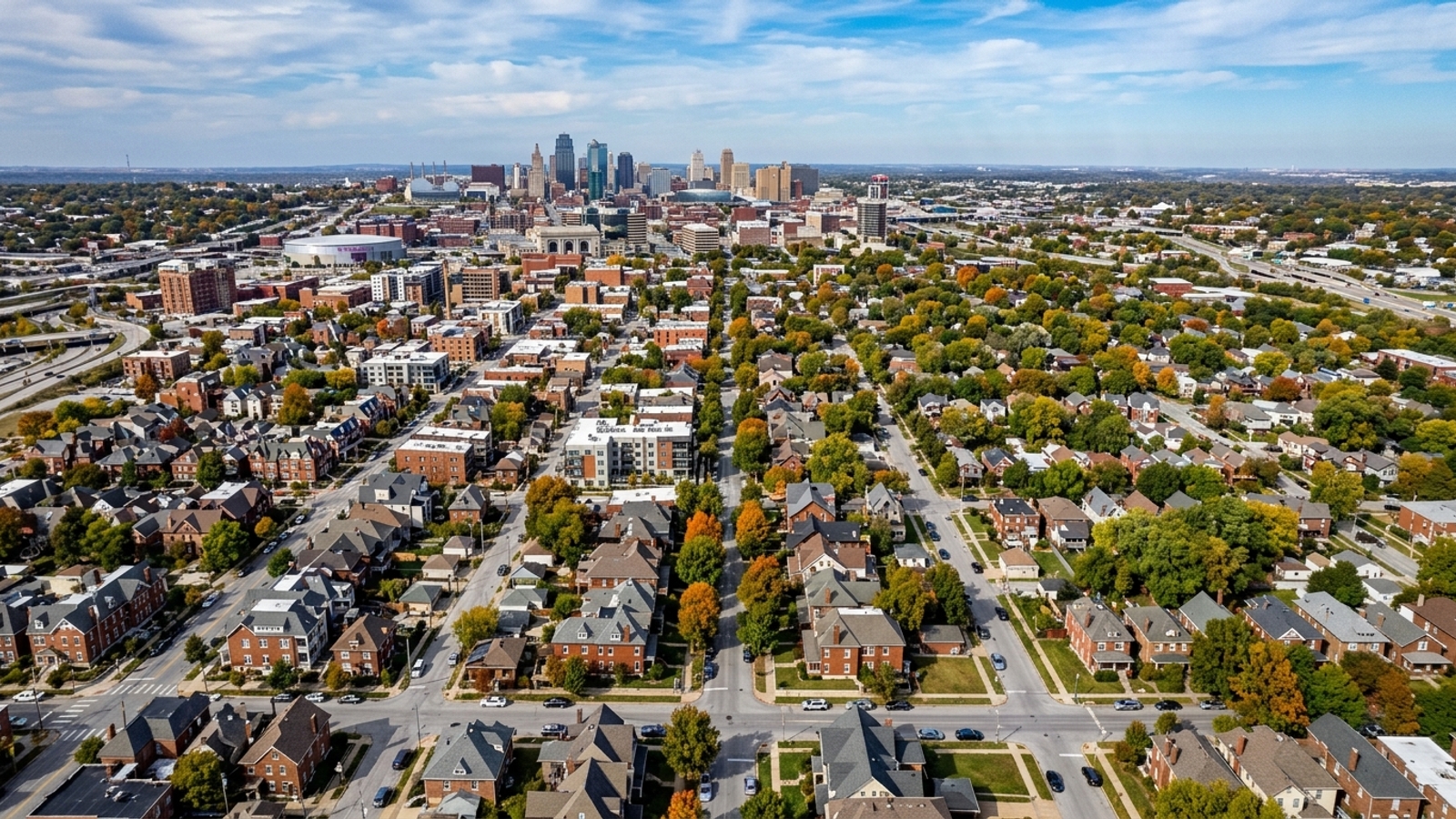
State Line Road literally cuts the metro in half – and if you’re shopping for a home in this region, you’re almost certainly going to end up comparing houses across a state border. Weighing the pros and cons of living in Kansas City, MO, against the Kansas side is a common first step. The Missouri side includes the urban core of Kansas City, MO, spanning Jackson, Clay, and Platte counties. The Kansas side covers Wyandotte County, home to Kansas City, Kansas, plus the suburban neighborhoods of Johnson County.
That border matters more than most buyers expect. You’re not just picking a neighborhood – you’re weighing median home values, property tax rates, and levies like the Missouri-side earnings tax, all of which affect what your actual monthly payment looks like. Getting clear on those differences is how you figure out which side of the line fits your budget.
Real Estate Prices and Housing Inventory
The median sale price in Kansas City, MO was approximately $325,000 as of May 2026, with homes spending roughly 21 days on the market. About 651 homes sold during that same period – a steady clip, not a slow burn.
Cross the state line and the numbers shift depending on which county you’re targeting. Wyandotte County, KS sits at the lower end of the metro’s pricing spectrum, while Johnson County, KS represents the higher end.
Comparing Median Sale Prices
That $325,000 Kansas City, MO median reflects an 8.3% year-over-year increase. If your priority is a lower purchase price, Wyandotte County, KS is worth a serious look – the median sale price there was around $240,000 in early 2026.
Johnson County, KS is a different story. The median sale price there reached $499,000 in June 2026. That’s a $250,000 gap between Wyandotte and Johnson counties, which means down payment requirements alone can vary dramatically depending on which part of the metro you choose.
Housing Styles Across the Metro
Kansas City, MO has a high concentration of historic homes, early 20th-century brick builds, and urban condos near the downtown districts – housing stock that reflects the city’s long-established neighborhoods and industrial history.
Wyandotte County offers a mix of mid-century single-family homes and newer infill development. Head south into Johnson County and the character shifts noticeably toward larger, newer construction and planned subdivisions.
Cost of Living and Local Taxes
Purchase price is only part of the calculation. Local taxes differ meaningfully across the state line, and those differences show up in your monthly payment whether you account for them upfront or not.
Missouri and Kansas structure their property assessments and local levies differently. Kansas City, MO also imposes a local earnings tax on residents and on non-residents who work within the city limits – something buyers relocating from out of state often don’t see coming.
Property Tax Rates
In Jackson County, MO, the median effective property tax rate generally falls between 1.11% and 1.49%, depending on the school and special district levies attached to a specific address. Assessed values and market values diverge here, so your actual tax bill will vary by neighborhood.
In Johnson County, KS, the median effective property tax rate runs from 1.09% to 1.27%. The county set its 2025 mill levy at 24.110 mills, but city and school district levies stack on top of that base rate to form your total bill.
Income and Sales Taxes
State income and sales taxes factor into the overall cost of living on both sides of the line. The Kansas City, MO earnings tax applies to income earned by city residents and to non-residents who work within city limits – it’s not just a consideration for locals.
When you’re comparing homes across the border, run the combined math: property taxes, state income taxes, and the earnings tax together. A lower purchase price in one county can be partially or fully offset by higher local taxes, which changes the long-term affordability picture in ways a simple price comparison won’t show you.
Commute Times and Geography
The Kansas City metro spans two states and multiple counties, but I-35, I-70, and I-435 tie it together well enough that most residents cross State Line Road daily without giving it much thought – for work, shopping, or recreation.
Where your commute actually lands depends entirely on where your employer sits relative to the house you’re considering.
Transportation Routes
Downtown Kansas City, MO is a major employment hub, as is Johnson County, KS, which has its own dense commercial districts. Those two anchors drive a lot of the real estate decisions people make in this metro.
Before you make an offer, map your expected commute during rush hour – not mid-morning on a Tuesday. A house in Wyandotte County might give you a fast, direct highway shot into downtown Kansas City, MO, while a home deeper in Johnson County could mean a longer run up I-35.
Parks and Amenities
Kansas City, MO maintains a large municipal park system with historic boulevards that weave green space into urban neighborhoods. The Kansas side has its own extensive county parks, paved trail networks, and retail centers.
The metro is interconnected enough that residents on either side of the line regularly cross over to visit museums, attend sporting events, or use trail systems. The state border is mostly a tax and legal distinction – day-to-day, it doesn’t fence anyone in.
Frequently Asked Questions
Is it more affordable to buy a house in Kansas City, MO, or just across the state line in KCK?
Wyandotte County generally offers the lower purchase price. The median sale price there was around $240,000 in early 2026, compared to the $325,000 median in Kansas City, MO.
Are property taxes generally higher for homeowners in Kansas City, Missouri, or Kansas?
It depends on the specific county and the local levies tied to the property. Jackson County, MO carries an estimated effective property tax rate between 1.11% and 1.49%. Johnson County, KS runs from roughly 1.09% to 1.27%. Both areas stack city and school district levies on top of their base county rates, so the address – not just the state – determines what you’ll actually owe.

Dani Beyer, a Kansas City native, began her career in real estate in 2004 after working in the tech industry. Since then, she's helped thousands of families turn their dreams into keys! Dani is now the CEO and Lead Listing Specialist of 'Dani Beyer Real Estate' brokered with Keller Williams KC North. With 820+ Five Star reviews, she specializes in helping buyer and sellers in the Kansas City Northland.