
There are a lot of things you expect to find when you buy a Kansas City home.
A basement? Probably. A sump pump? Wouldn’t surprise us. A little “character” in a house built in 1964? Absolutely.
Radon? That’s one houseguest you definitely don’t want hanging around.
Radon is a naturally occurring radioactive gas that comes from the breakdown of uranium in soil and rock. It’s invisible, odorless, and tasteless—which is a particularly rude combination for something you probably don’t want accumulating in your home.
And yes, Kansas City is an area where radon testing deserves to be taken seriously.
What Exactly Is Radon?
Let’s start with the basics.
Radon is a radioactive gas that naturally occurs in the soil. It can move through cracks and openings in a home’s foundation and accumulate indoors.
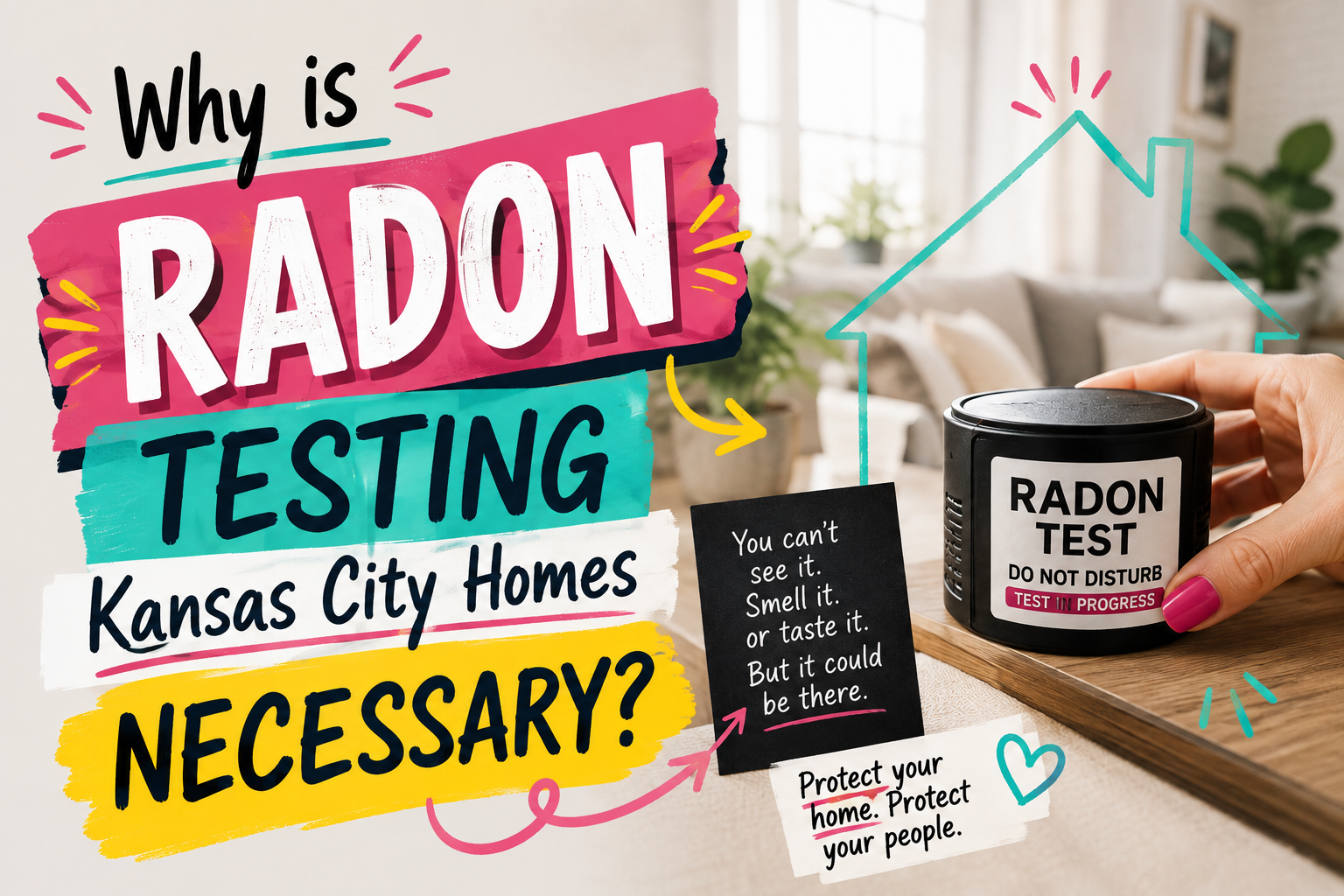
You can’t see it. You can’t smell it. You can’t taste it.
In other words, your nose is not going to save you here.
The only way to know whether your home has elevated radon levels is to test for it.
According to the U.S. Environmental Protection Agency (EPA), radon is the leading cause of lung cancer among nonsmokers. The EPA recommends taking action to reduce radon when levels reach 4.0 picocuries per liter (pCi/L) or higher and considering action between 2.0 and 4.0 pCi/L. (US EPA)
That’s why radon testing is an important part of understanding a home’s overall condition—especially when you’re buying.

Why Is Radon Such a Big Deal in Kansas City?
Here’s where our geography comes into play.
Both Kansas City, Missouri, and Kansas City, Kansas, are designated EPA Radon Zone 1 areas, meaning they have the highest potential for homes to test above the EPA’s recommended action level. (US EPA)
And this isn’t just a Kansas City thing. Much of the Heartland—including Kansas and Missouri—is in areas with moderate to high potential for elevated radon.
Missouri’s Department of Health and Senior Services reports that radon is present in every county in Missouri, and its residential testing data shows that about 1 in 3 homes tested had results at or above 4.0 pCi/L. (Missouri Health Services)
So if you’re thinking, “But my neighbor’s house tested fine,” unfortunately, geology does not care about neighborhood gossip. Every house is different.
Does Having a Basement Make Radon More Likely?
Not necessarily—but basements and other areas closest to the ground are important places to consider when testing.
Radon enters homes from the soil beneath and around them. It can move through:
- Cracks in concrete
- Floor drains
- Sump pits
- Gaps around pipes
- Construction joints
- Crawl spaces
- Other openings in a foundation
And because radon can accumulate indoors, the EPA recommends testing the lowest level of the home that could be regularly occupied.
That means a finished basement where the kids hang out, your home office lives, or your spouse has claimed the TV is particularly relevant.
 “But My House Is Brand New.”
Congratulations! You have shiny cabinets and that new-house smell.
Unfortunately, new construction doesn’t automatically mean radon-free construction. Radon can affect old homes, new homes, brick homes, ranch homes, two-story homes, homes with basements, and homes without basements. The age of the house isn’t a reliable way to determine whether testing is necessary.
The EPA’s advice is refreshingly simple: test your home. (US EPA)
“What If My House Doesn’t Have a Basement?”
Still test. Radon isn’t exclusively a basement problem.
Homes with crawl spaces or slab foundations can also have elevated radon levels. The gas can enter through openings in or around the foundation and accumulate indoors.
So don’t assume you’re off the hook just because your house doesn’t have a basement full of holiday decorations and things you swear you’re going to organize someday.
What Happens During a Radon Test?
The good news: it’s not particularly exciting. And that’s exactly what you want.
A radon test involves placing a testing device in the home for a specified period of time. Short-term tests are commonly used during real estate transactions.
For a typical home purchase, your real estate agent and inspector can help coordinate the testing process and explain how the results fit into the inspection and negotiation process.
Testing conditions matter, too. For example, Missouri’s health department recommends closed-house conditions for short-term testing, meaning windows generally remain closed and exterior doors are kept closed except for normal entry and exit. (Missouri Health Services)
And because radon testing associated with a real estate transaction can have specific requirements, it’s important to use an appropriately qualified professional.
What Does a Radon Number Actually Mean?
This is where a lot of buyers see a number on a report and immediately think:
“Is that bad?”
The EPA’s general guidance is:
Below 2.0 pCi/L
Generally considered a lower level, although there is no known completely risk-free level of radon exposure.
2.0–4.0 pCi/L
The EPA recommends considering ways to reduce the level.
4.0 pCi/L or higher
The EPA recommends taking action to reduce radon levels. (US EPA)
And here’s something important:
A high radon result does not automatically mean “RUN AWAY FROM THE HOUSE.”
Radon can be mitigated.
What Happens If a House Tests High?
This is where buyers sometimes panic unnecessarily.
A high radon reading doesn’t mean the house is doomed. Radon mitigation systems are designed to reduce radon concentrations by venting the gas from beneath the home to the outside.
According to the EPA’s 2026 Region 7 guidance, radon reduction systems can reduce indoor radon levels by as much as 99%. (US EPA)
Depending on the home and the system needed, mitigation can be a manageable solution rather than a deal-breaking disaster.
That’s where having an experienced real estate agent matters.
A radon result becomes a negotiation and decision-making conversation, not necessarily a “throw the entire house into the nearest volcano” situation.
Should I Test for Radon When Buying a Kansas City Home?
If we haven’t made it clear yet, YES. We think it’s, at minimum, worth considering—especially given the radon potential throughout the Kansas City area.
A home inspection can tell you a lot about the physical condition of a property, but radon isn’t something you can identify by looking at the foundation and saying, “Yep, seems radioactive.”
You have to test.
And because radon levels can change over time, a previous test isn’t necessarily a permanent lifetime certificate of radon-free living.
If you’re buying a home, talk with your inspector and real estate agent about whether radon testing should be included as part of your due diligence.
For All the Visual Learners Out There…
If you’re the kind of person who would rather watch someone explain radon than read a novel about picocuries, we’ve got you covered.
DBRE partners with Certified Radon to provide additional radon education, including videos that explain what radon is, how testing works, and what happens when a home has elevated levels.
They’re a great resource if you’re buying a home and want to understand the process before a test lands on your inspection report.
Because let’s be honest: seeing the words “RADON: 8.2 pCi/L” on a report without knowing what you’re looking at can make even the calmest buyer Google themselves into a full-blown panic.
SO, Test, Don’t Guess
Radon isn’t something you should lose sleep over—but it is something you should take seriously. Kansas City sits in an area where elevated radon levels are a legitimate concern. Both sides of the metro have been identified as high-potential areas, and Missouri data shows elevated results are not uncommon.
The good news?
Radon is detectable. Radon is manageable. And radon mitigation is possible.
So when you’re buying a Kansas City home, add radon testing to the list of things worth knowing about before you make one of the biggest purchases of your life. But when it comes to something you can’t see, smell, or taste, it’s better to test than guess.
Buying a Home in Kansas City?
At Dani Beyer Real Estate, we believe our job isn’t just to help you find a house you love. It’s to help you understand what you’re actually buying—including the stuff that doesn’t show up in the listing photos.
If you’re buying or selling a home in the Kansas City area, we’re here to help you navigate the questions, inspections, negotiations, and occasional “well, that’s interesting” moments that come with real estate.
Buying a home is exciting. Figuring out what’s hiding in it? That’s where having a good real estate team comes in.

Dani Beyer, a Kansas City native, began her career in real estate in 2004 after working in the tech industry. Since then, she's helped thousands of families turn their dreams into keys! Dani is now the CEO and Lead Listing Specialist of 'Dani Beyer Real Estate' brokered with Keller Williams KC North. With 820+ Five Star reviews, she specializes in helping buyer and sellers in the Kansas City Northland.