
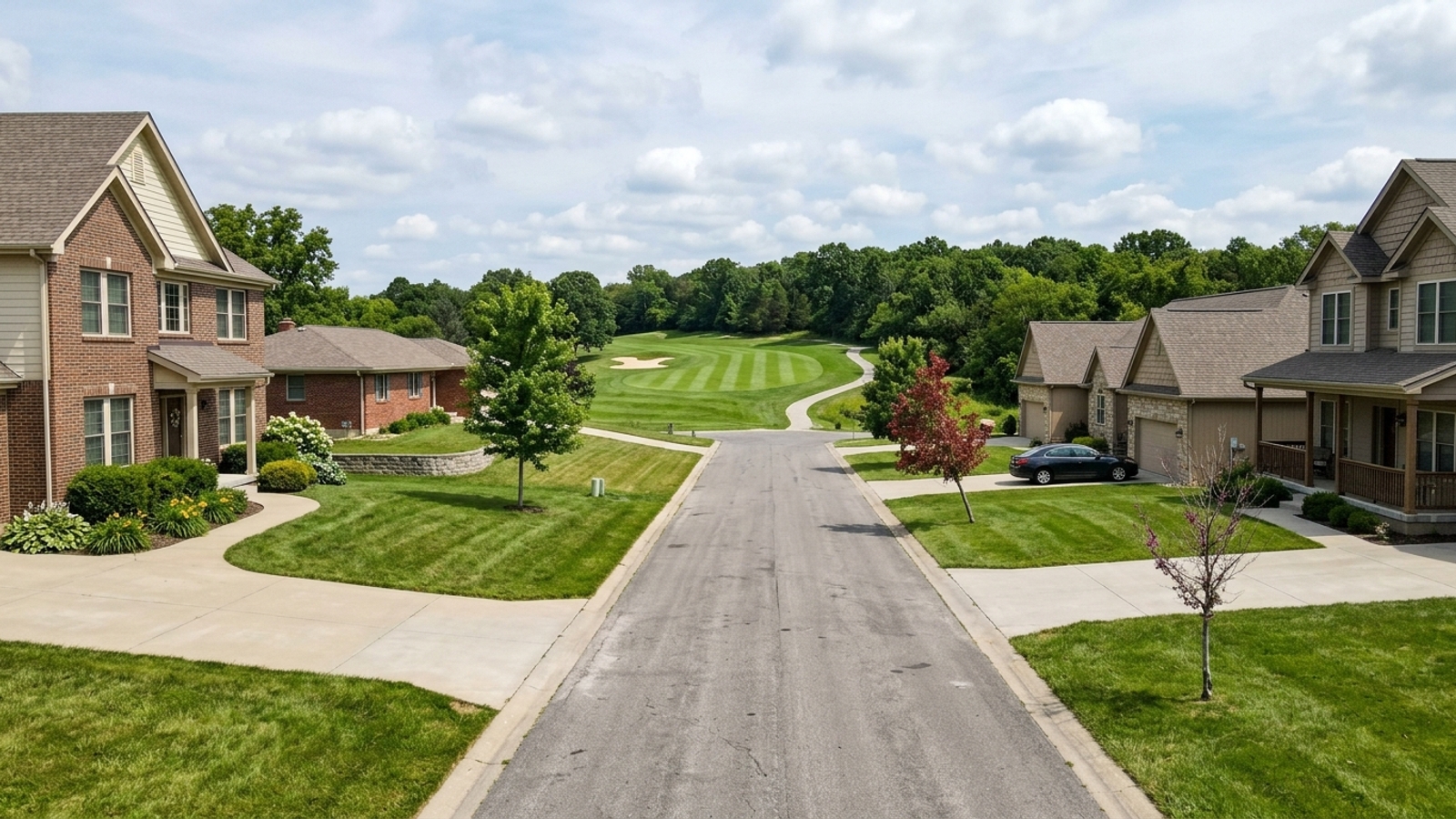
A fairway view changes how you buy a house. In Kansas City, moving onto a golf course means evaluating two separate purchases: the property itself and the club access that comes with it.
Key Takeaway
If you want golf-community living with the most room to negotiate in Kansas City right now, start with condos and villas. City-wide condo prices fell 12.5% over the latest 90 days, while single-family prices rose. If you want a detached home on the course, plan to pay close to asking, and get the club’s membership costs in writing before you compare communities.
Who This Guide Is For
You’re weighing a home in or near a Kansas City golf community, deciding between an attached condo or villa and a detached house, and working out what club membership will add to the real cost.
Kansas City Golf Community Housing Market
Attached and detached homes are moving in opposite directions, so the property type you choose decides whether you negotiate or compete. City-wide, condos have 7.3 months of supply against 3.1 for single-family homes, based on the 90 days ending October 31. We outline these property options in our breakdown of living in a golf community in Kansas City.
Condos and Villas
Condos give you the most room to negotiate. On a hypothetical $200,000 asking price, the city-wide condo sale-to-list ratio puts a likely close near $193,200. That’s roughly $6,800 under asking before any membership costs. With 222 condos recently listed across the city, you have alternatives to walk to if a seller won’t move. If you’re selling a larger home to move into a villa, it’s worth comparing a cash offer against traditional financing.
The trade-off: condos run higher per square foot than houses here.
Townhouses
Townhouses sit between condos and detached homes in both price and pace. Prices dipped 2.3% year over year, but they still sell quickly, which gives you modest price room. Supply is the tightest of any home type at 2.5 months, so few townhouses sit inside golf communities at any one time. The right one may not be listed when you’re ready to move.
Single-Family Homes
Detached homes, including most fairway lots, are still in a seller-leaning market. Single-family home prices rose year over year, and more than a quarter sold above asking in the latest 90 days. Come pre-approved, expect offers near asking, and be ready to compete for the best course-view lots. Review mortgage rates and payments early so you set a firm budget before you fall for a specific lot.
City-wide figures don’t capture any premium for backing onto a fairway. Before deciding what a view is worth, ask for sold comps inside the community, on and off the course, with days on market.
How Golf Memberships Work
Living on a golf course doesn’t automatically mean you can play it. Course access follows one of three models, and each shapes your monthly costs and how easily the home resells.
Mandatory or Bundled Membership
Some communities tie club membership to the deed or covenants, so every owner pays dues. Read the declaration and covenants to confirm whether membership is mandatory; don’t assume from a neighborhood’s name or gates. Because the dues follow the house, the next buyer must pay them too. That narrows your future buyer pool to people willing to pay for golf, even if you stop playing.
Optional Private Club Membership
Here, the home and the club are separate purchases. You can live on the course without joining, but access and perks require initiation fees plus monthly dues. The National Golf Club of Kansas City in Parkville, MO, is a private club, and homeowners in the surrounding neighborhood aren’t required to join. Membership is handled as a separate transaction through the club operator, and some homeowners never join at all. Private clubs rarely publish their fees, so you can’t compare true costs online.
Public Courses With No Membership
Homes beside municipal or daily-fee courses give you the view and access without an initiation fee or a monthly club bill; you pay standard rates to play. What you give up is control. You share the course and parking lot with every daily-fee player, and neither homeowners nor the HOA have a say over upkeep or the course’s long-term future.
Kansas City Golf Communities to Start With
The National
The National is a golf-estates community in Parkville built around a private course designed by Tom Watson. The golf, fitness, pool, tennis, and dining facilities are owned and operated by Invited, while homes belong to their owners and the neighborhood HOA. Expect a single-family price in a competitive segment, plus club dues if you join.
Chapel Ridge
Chapel Ridge Golf Club is at 3750 NE Ralph Powell Road in Lee’s Summit, MO. It’s a public course designed by Charles Bondurant that opened in 1958, though some directories list it as semi-private. It offers course-adjacent living with daily-fee access rather than a mandatory private club. Confirm which city and county the specific parcel falls in rather than relying on the neighborhood name.
The Northland
The Northland isn’t a single community; it’s the area to search for homes near courses without an initiation fee. Shoal Creek Golf Course is a public, daily-fee course owned by Kansas City Parks and Recreation, so no club membership is required to play. Nearby Staley Farms Golf Club is built around a private golf club model instead. Being near a course isn’t the same as being in a golf community: you won’t get HOA-backed course upkeep, and most homes don’t back onto the course.
Costs Beyond the Purchase Price
Property taxes depend on the parcel’s county and tax rate, so look up each address on the county assessor’s site before comparing communities. Budget for standard buyer closing costs, then for the ongoing layers golf living adds.
HOA Dues
Golf-community HOA fees often run higher than those in typical subdivisions. Ask the HOA for:
- current dues
- what the dues cover, including any part of the course or surrounding common areas
- the latest budget
- the reserve study
If the HOA owns or subsidizes course land and the reserve fund is thin, a special assessment is a real possibility.
Club Initiation Fees and Monthly Dues
Before you write an offer, get the following from the club in writing:
- the current initiation fee
- monthly dues
- the food and beverage minimum
- cart or trail fees
Also ask whether any part of the initiation fee is refundable or transfers to the next owner when you sell. Food and beverage minimums are billed whether or not you eat at the club, and dues can rise after you join.
Special Assessments and Course Upkeep
Course ownership decides who pays for irrigation, clubhouse repairs, or fairway renovations. Ask whether the HOA, a private club, or a third-party operator owns the course. Request the special assessment history and details of any planned capital projects. If a third-party owner closes or sells the course, the open space your home was priced on could change, so ask what the deed restrictions and zoning allow for the land before you sign.
Pros and Cons of Living on a Golf Course
Fairway lots bring real benefits and specific nuisances, and both depend on exactly where your lot sits.
Views and Open Space
The upside is long sightlines and no neighbor directly behind you. View quality depends on whether you face a tee box, a green, or the middle of a fairway. Visit on a weekend morning to see play traffic and sightlines from the yard. Then go back at dawn, when maintenance crews typically mow and irrigate, to judge whether you can live with the noise.
Errant Golf Balls and Privacy
Lots on the right side of a fairway for right-handed players and near tee landing zones take more balls. Missouri has no golf-ball-liability statute; the rule comes from case law. A golfer owes a duty of ordinary care only to those within the line of play, with generally no liability for property outside that line unless the golfer intended to hit the ball that far. Ask your insurer how golf ball damage to windows, siding, and vehicles is handled under your policy. Players can also see into your yard, and HOA rules may restrict the fences or netting you could use to block them.
Resale Value
The soft market that helps you negotiate on a condo works against you when you sell: a typical Kansas City condo takes nearly three times as long to sell as a single-family home right now. If you might sell within a few years, factor that wait in before choosing an attached home. Use the in-community comps to see how long on-course homes took to sell.
How to Choose a Golf Community in Kansas City
The right property depends on how you plan to use it.
- Do you want to play the course regularly, or mainly live beside it? If you’ll play, start with How Golf Memberships Work and Club Initiation Fees and Monthly Dues. If not, look at Public Courses With No Membership and The Northland.
- Is your budget closer to the condo range or the single-family range in the at-a-glance list? Below single-family, see Condos and Villas and Townhouses. At or above it, see Single-Family Homes and The National.
- Would you rather negotiate on price or compete for the house? Negotiators start with Condos and Villas. If you’re ready to move fast, read Single-Family Homes.
- How long will you stay? If it may be under five years, read Resale Value before choosing an attached home.
If you want a detached home with course views and a private club, start with The National. If you want low maintenance without the long condo resale wait, townhouses in or near golf communities are a solid match. If you want course access with no initiation fee, target the Northland near public courses. When youre ready to start touring, reach out to a local real estate agent who knows the golf communities in Kansas City.
At a Glance
Note that these are city-wide Redfin figures, not golf-community figures.
- All homes, Kansas City (90 days ending 2026-10-31): median sale price $304,788, up 5.1% year over year; 3.4 months of supply; median $169 per square foot
- Single-family homes, Kansas City (90 days ending 2026-10-31): median sale price $319,818, up 6.6% year over year; 26 median days on market; 98.9% sale-to-list; 27.8% sold above list; 3.1 months of supply
- Condos, Kansas City (90 days ending 2026-10-31): median sale price $198,946, down 12.5% year over year; 74 median days on market; 96.6% sale-to-list; 6.6% sold above list; 7.3 months of supply; 222 listed
- Condos vs. single-family, Kansas City (90 days ending 2026-10-31): median $214 per square foot for condos vs. $169 for single-family homes
- Townhouses, Kansas City (90 days ending 2026-10-31): median sale price $229,486, down 2.3% year over year; 31 median days on market; 98.3% sale-to-list; 2.5 months of supply; 65 listed
Kansas City Golf Community FAQs
Can You Get an FHA Loan on a Golf Community Condo in Kansas City?
Yes, if the condo project is on HUD’s FHA-approved list, which you can search online before writing an offer, or if the unit qualifies through Single-Unit Approval. Single-Unit Approval requires a project that isn’t already FHA-approved, is complete, has at least five units, isn’t a manufactured home, and meets FHA standards for insurance concentration, owner occupancy, and financial condition.
Can You Drive a Golf Cart on Streets in Kansas City, MO?
No. Under Missouri law, golf carts are legal on city streets only where a municipality authorizes them by resolution or ordinance, and Kansas City hasn’t. City officials treat a cart on a public street as a motor vehicle needing state license plates, which golf carts can’t obtain. HOA rules inside a private community can be stricter still.
What County Is a Kansas City Golf Community In?
It depends on the exact address, since Kansas City spans multiple counties. The National, in Parkville, is in Platte County.
How Far Is the National from Downtown Kansas City?
It’s roughly a 17 to 20-minute drive, about 10 to 11 miles northwest of downtown Kansas City, MO.
Can You Rent Out a Golf Community Home as a Short-Term Rental in Kansas City?
Yes, with a valid, unexpired short-term rental registration from the city. You register through the CompassKC portal for a yearly fee of $200, which the city can adjust for inflation. HOA covenants may still ban or limit rentals regardless of the city registration.
Can You Buy a Golf Course Lot and Build in Kansas City?
Yes, in new home developments that still have vacant lots along the fairways. Ask whether the community requires an approved builder list, architectural review, and build-start deadlines, and confirm any course easements on the survey.
Sources
- Redfin: Data Center
- Sweeney Team KC: What Your Money Buys Inside The National
- Wikipedia: National Golf Club of Kansas City
- Wikipedia: Parkville, Missouri
- Golf Missouri: Chapel Ridge Golf Club
- Shoal Creek Golf Course: About
- JustAnswer: Golf Ball Liability
- HUD: Single Family Condominiums
- Municode: Kansas City Code of Ordinances
- KC BizCare: Short-Term Rentals

Dani Beyer is a Kansas City native, experienced REALTOR®, and CEO and Lead Listing Specialist of Dani Beyer Real Estate, brokered by Keller Williams KC North. With over 20 years of real estate experience, Dani has helped thousands of buyers and sellers navigate the Kansas City housing market. Specializing in Kansas City Northland real estate, including Parkville, Platte County, and Clay County, Dani is known for her local market expertise, strategic home-selling approach, and commitment to exceptional client service. Backed by more than 1,050 five-star Google reviews, Dani and her team are trusted resources for buying, selling, and relocating throughout the Kansas City metro area.